Toni Chant - You’re a dynamic teacher! When I had the pleasure of working in your classroom, I was so amazed by the sense of classroom community. The rituals and routines that you’ve established with your students are so unique. Please share with me some of your favorite classroom routines and rituals and how I can adapt them to a 4th grade classroom. (Shea Beaudreau)
Dear Shea,
Thank you, first of all, for gracing us with your amazing gifts and tender heart. I was delighted to have such a talented and passionate teacher share in our classroom life. Here are some of my personal beliefs that facilitate learning in and out of our classroom.
Create opportunities to build relationships. Why? Relationships build trust.
Trust leads to risk. The rest is history.
My most favorite things:
Daily: Greet each student at the door with a smile, and a hug or pat on the back. This brief exchange helps set the tone for the day and provides insight on the mood of the students. Personally, I love the feeling of coming home and being welcomed at the door by my husband with a hug and a smile.
Beginning of each week: We all come together as a class to share in one happy or sad experience we each might have had over the weekend. We all sit in a circle and take turns speaking and listening. I love, love, love doing this! We get to know each other and everyone has a chance to work on listening and speaking skills. This strategy is an off shoot of the seminar dialogue.
Whenever we gather together on the carpet, if possible, we all sit in a circle facing each other. This is a great strategy to use during the closing session of the workshop model. Students feel less crowded, are able to work on listening skills while keeping their eyes on the speaker. This has worked very well for us this year. The best part about this is that I can sit in between students who might need extra support academically or behaviorally. It's like sitting at the dinner table sharing our experiences.
The Hitching Post: I have a place available for the students to leave me notes about anything that's on their mind such as questions, comments, concerns, request for student/teacher conference or information. Sometimes students might be reluctant to ask questions in front of their peers. This is a 'sneaky' way to encourage students to write. I read and address the notes daily. This ritual has reduced unusual conversation during instruction, as well.
The last thing that I would like to share is our goodbye dance at the end of each week. We dance and sing our way out the door as we celebrate each other, from YMCA to the Handjive. Stop by any Friday afternoon, jump up on a table, and celebrate the week with us. The students always leave with a smile.
I wish you the very best next year!
With love,
Friday, May 16, 2008

ESE and Gen Ed (Lourdes Santiago)
Dear Lourdes,
We both started in December and transitioned into very different roles in the classroom. Every time I see you, there is a smile on your face and you seem so calm and relaxed. It is obvious that you’re enjoying teaching 2nd grade. How has your ESE background helped prepare you for working in a 2nd grade ELA classroom as a General Ed. teacher? When you switch roles next year and become an ESE teacher, how do you think your experience as an ELA teacher will enrich your teaching strategies?
Sincerely,
Shea
P.S. - I can’t wait to work with you next year!!!
Dear Shea,
It has been a wonderful and enriching experience coming to CCE! I feel that dreams really do begin here! With this said, I have truly enjoyed teaching 2nd grade. I must say that my ESE background helped prepare me in many areas for the General Ed. ELA classroom. I feel that it is clear to me which students need an extra hand academically and perhaps some extra attention in the area of TLC as well. It can be overwhelming to a student that learns differently or takes a longer time to process information when their peers just seem to “get it” right away. I have always enjoyed providing individual and small group instruction and support. I have been trained to pay attention to “red flags” and do not mind dedicating time to preparing extra worksheets or materials for extra practice and taking on tutoring as needed. It feels so rewarding when a student shows significant improvement because of the extra help that I have provided to them. Some students need this extra support and benefit extremely from a second person being available to them, be it an ESE teacher or a second teacher in a co-teach situation.
Now that I have taught in a whole group setting, I can really appreciate all of the duties General Education teachers take on. There is so much to do with so many students. An incredible amount of work goes into preparation of units, lessons, and materials. There is so much more to being a teacher than just the academics, though, and it is easier to comprehend how this can be overwhelming at times. As an ESE teacher next year, I feel that I can better relate to how a classroom is run and when strategies can be implemented without interrupting the students (or teacher’s) day. Now, I have a clear understanding of routines and scheduling in addition to how to better reach those struggling learners. Simple interventions to more intensive ones seem clearer to me in an inclusion setting.
My internship consisted of teaching special needs students in grades Kindergarten through Fifth grades. I would pull students out for smaller group instruction and work in the classroom providing accommodations alongside their General Education teachers. I would have to plan out in advance according to each teacher’s schedule, what each class was working on and modify materials and tests. Under the direction of an excellent cooperating teacher, I was able to gain a wealth of knowledge in keeping up with it all and cover each area so that students can improve their skills in all subject areas. Shea, it surprises me that you feel I seem so calm and relaxed as there just seems to be so much to do and so little time. I look at different tasks at hand and do them in the order of priority. I try not to think too far ahead (especially with all the E.O.Y. deadlines approaching) and take it one step at a time. I feel that this is what has kept me sane (while productive) as I have learned my new role coming to CCE midway into the year.
I admire you and all that you bring to CCE! I know that next year will be an excellent year. I look forward to working closely with you to assure the needs of each of our students are met.
Sincerely,
Lourdes Santiago
We both started in December and transitioned into very different roles in the classroom. Every time I see you, there is a smile on your face and you seem so calm and relaxed. It is obvious that you’re enjoying teaching 2nd grade. How has your ESE background helped prepare you for working in a 2nd grade ELA classroom as a General Ed. teacher? When you switch roles next year and become an ESE teacher, how do you think your experience as an ELA teacher will enrich your teaching strategies?
Sincerely,
Shea
P.S. - I can’t wait to work with you next year!!!
Dear Shea,
It has been a wonderful and enriching experience coming to CCE! I feel that dreams really do begin here! With this said, I have truly enjoyed teaching 2nd grade. I must say that my ESE background helped prepare me in many areas for the General Ed. ELA classroom. I feel that it is clear to me which students need an extra hand academically and perhaps some extra attention in the area of TLC as well. It can be overwhelming to a student that learns differently or takes a longer time to process information when their peers just seem to “get it” right away. I have always enjoyed providing individual and small group instruction and support. I have been trained to pay attention to “red flags” and do not mind dedicating time to preparing extra worksheets or materials for extra practice and taking on tutoring as needed. It feels so rewarding when a student shows significant improvement because of the extra help that I have provided to them. Some students need this extra support and benefit extremely from a second person being available to them, be it an ESE teacher or a second teacher in a co-teach situation.
Now that I have taught in a whole group setting, I can really appreciate all of the duties General Education teachers take on. There is so much to do with so many students. An incredible amount of work goes into preparation of units, lessons, and materials. There is so much more to being a teacher than just the academics, though, and it is easier to comprehend how this can be overwhelming at times. As an ESE teacher next year, I feel that I can better relate to how a classroom is run and when strategies can be implemented without interrupting the students (or teacher’s) day. Now, I have a clear understanding of routines and scheduling in addition to how to better reach those struggling learners. Simple interventions to more intensive ones seem clearer to me in an inclusion setting.
My internship consisted of teaching special needs students in grades Kindergarten through Fifth grades. I would pull students out for smaller group instruction and work in the classroom providing accommodations alongside their General Education teachers. I would have to plan out in advance according to each teacher’s schedule, what each class was working on and modify materials and tests. Under the direction of an excellent cooperating teacher, I was able to gain a wealth of knowledge in keeping up with it all and cover each area so that students can improve their skills in all subject areas. Shea, it surprises me that you feel I seem so calm and relaxed as there just seems to be so much to do and so little time. I look at different tasks at hand and do them in the order of priority. I try not to think too far ahead (especially with all the E.O.Y. deadlines approaching) and take it one step at a time. I feel that this is what has kept me sane (while productive) as I have learned my new role coming to CCE midway into the year.
I admire you and all that you bring to CCE! I know that next year will be an excellent year. I look forward to working closely with you to assure the needs of each of our students are met.
Sincerely,
Lourdes Santiago
Thursday, May 15, 2008
New Ideas (Shea Beaudreau)
Shea Beaudreau-You have eased seamlessly into the Chets Creek culture as if you have been here from day one. You are a flawless and articulate teacher and such a pleasant colleague and friend. I know that you have taught just as wonderfully in another very high performing school. What ideas can you share with us that you bring from your past experiences? I am always eager to learn from various perspectives! (Jen Zawis)
Dear Jen,
Thanks for your sweet words. I feel so blessed to be at Chets where I can grow as a professional. Chets is so unique and has so many positive rituals and routines that make it a one-of-a-kind learning community. At my previous school, there are two ideas that were very successful that I’d like to share:
Writing Coach - As a writing teacher at heart, I always helped support my colleagues implement new strategies with their students. Two of the years I taught fourth grade, I served as a writing coach for my team. Part of my day was dedicated to modeling writing lessons in the classrooms and training my colleagues. Especially in fourth grade, writing seems to be an area that some teachers feel they need more training and support to confidently teach their students. On early release Wednesdays, we had a different version of WOW - Writing on Wednesdays- when all of our school learned a new writing strategy.
ELA/Social Studies Integration - In our school, the ELA teacher also taught the social studies curriculum, which allowed the the subjects to be integrated. I know we are always trying to find ways to fit it all in, so I always felt the two subjects areas were a good match for integrating reading and writing standards.
There are other successful ideas that I’d be happy to share, so please just ask!
- Shea
Dear Jen,
Thanks for your sweet words. I feel so blessed to be at Chets where I can grow as a professional. Chets is so unique and has so many positive rituals and routines that make it a one-of-a-kind learning community. At my previous school, there are two ideas that were very successful that I’d like to share:
Writing Coach - As a writing teacher at heart, I always helped support my colleagues implement new strategies with their students. Two of the years I taught fourth grade, I served as a writing coach for my team. Part of my day was dedicated to modeling writing lessons in the classrooms and training my colleagues. Especially in fourth grade, writing seems to be an area that some teachers feel they need more training and support to confidently teach their students. On early release Wednesdays, we had a different version of WOW - Writing on Wednesdays- when all of our school learned a new writing strategy.
ELA/Social Studies Integration - In our school, the ELA teacher also taught the social studies curriculum, which allowed the the subjects to be integrated. I know we are always trying to find ways to fit it all in, so I always felt the two subjects areas were a good match for integrating reading and writing standards.
There are other successful ideas that I’d be happy to share, so please just ask!
- Shea
Thursday, May 8, 2008
Advice from New Situations (Shea Beaudreau)
Dear Shea,
I have worked with you since December and have loved every minute. Not all people can come to a new school in the middle of the year, juggle servicing two grade levels in the beginning, and do it with the grace you have accomplished.
What advice can you give to teachers that are about to enter a new and unknown situation? What words of wisdom can you share with these new teachers?
Thank you,
Terri
Dear Terri,
Thank you for the opportunity to share my thoughts and experiences about teaching. Even though this is my eleventh year of teaching, I am still learning every day. Each year of teaching brings new joys and challenges and more opportunities to add to my repertoire of strategies to reach all learners. In response to your question, I have many words of wisdom to share with my colleagues entering a new and perhaps unknown situation. First let me note that Chets already does a fabulous job establishing these supports as part of their rituals and routines.
Be Flexible - Rise to the challenge! Always be open to new possibilities and be willing to try new things. Change causes you to grow and you often realize you can accomplish things you never knew you could do.
Time Management & Organization - Prioritize your “to-do” list. Learn all of the time-saving tips that you can and beg, borrow, and steal every organizational strategy and tool to implement in your classroom and office. I love visiting other teachers’ classrooms so I can see what is working for them. I can always tweak a strategy to meet my needs.
Communication is Key - It is vital to express your concerns about entering a new grade and offer suggestions to make the transition smooth. If you need support with a particular area, ask for help BEFORE you become overwhelmed!
Learn from a mentor(or two!) - I think it is key to learn from other skilled teachers who are willing to share their ideas and their classrooms for observation. Even after our first year of teaching, we all need good role models! I can’t begin to tell you how many good ideas I’ve learned from my co-teachers over the years and since arriving at Chets.
Read, Read, Read & Research some more - There are so many rich resources available to us, especially considering that the Internet allows us to connect to other educators around the world. Join a book study about an area you want to learn more about or participate in a blog about a topic of interest.
Surround Yourself with Professionals - At Chets, there are countless opportunities (weekly meetings, team meetings, staff meetings, book studies, WOW days) to be in good company and learn from other professionals, but it is also helpful to attend workshops, join an organization, travel to major conventions, and connect with other education professionals via the Internet.
Avoid Isolation - Collaborate and interact with your colleagues in and out of school as often as possible. It is so crucial to communicate your concerns and celebrate your successes. If you need support, DON’T be afraid to reach out and ask!
Thanks for asking! - Shea
I have worked with you since December and have loved every minute. Not all people can come to a new school in the middle of the year, juggle servicing two grade levels in the beginning, and do it with the grace you have accomplished.
What advice can you give to teachers that are about to enter a new and unknown situation? What words of wisdom can you share with these new teachers?
Thank you,
Terri
Dear Terri,
Thank you for the opportunity to share my thoughts and experiences about teaching. Even though this is my eleventh year of teaching, I am still learning every day. Each year of teaching brings new joys and challenges and more opportunities to add to my repertoire of strategies to reach all learners. In response to your question, I have many words of wisdom to share with my colleagues entering a new and perhaps unknown situation. First let me note that Chets already does a fabulous job establishing these supports as part of their rituals and routines.
Be Flexible - Rise to the challenge! Always be open to new possibilities and be willing to try new things. Change causes you to grow and you often realize you can accomplish things you never knew you could do.
Time Management & Organization - Prioritize your “to-do” list. Learn all of the time-saving tips that you can and beg, borrow, and steal every organizational strategy and tool to implement in your classroom and office. I love visiting other teachers’ classrooms so I can see what is working for them. I can always tweak a strategy to meet my needs.
Communication is Key - It is vital to express your concerns about entering a new grade and offer suggestions to make the transition smooth. If you need support with a particular area, ask for help BEFORE you become overwhelmed!
Learn from a mentor(or two!) - I think it is key to learn from other skilled teachers who are willing to share their ideas and their classrooms for observation. Even after our first year of teaching, we all need good role models! I can’t begin to tell you how many good ideas I’ve learned from my co-teachers over the years and since arriving at Chets.
Read, Read, Read & Research some more - There are so many rich resources available to us, especially considering that the Internet allows us to connect to other educators around the world. Join a book study about an area you want to learn more about or participate in a blog about a topic of interest.
Surround Yourself with Professionals - At Chets, there are countless opportunities (weekly meetings, team meetings, staff meetings, book studies, WOW days) to be in good company and learn from other professionals, but it is also helpful to attend workshops, join an organization, travel to major conventions, and connect with other education professionals via the Internet.
Avoid Isolation - Collaborate and interact with your colleagues in and out of school as often as possible. It is so crucial to communicate your concerns and celebrate your successes. If you need support, DON’T be afraid to reach out and ask!
Thanks for asking! - Shea
Sunday, May 4, 2008
Gifted (Jen Zawis)
Jen Zawis- What a challenge to work with gifted students! I know that their quirks can be hard to decipher. How do you keep students focused when they are all so different? No child left behind is applicable to our high-level students as well. What suggestions do you have for regular education teachers to differentiate our instruction? (Kristin Shannon)
Dear Kristin,
I absolutely agree with you- teaching gifted children can be quite challenging and they certainly are a quirky bunch at times! I have to say, however, that those idiosyncrasies are what fascinate me and often what I love most about gifted children.
As you mentioned, it is so important to address the fact that NCLB is applicable to gifted students, and that they too must receive differentiated instruction in the classroom. I think that so often we fall into the habit of assuming that these children will just “get it” and manage to stay afloat on their own. I certainly have been guilty of thinking that way in the past without even really being conscious that I was doing so, and therefore likely not met their needs as individuals.
Fortunately, the more time that I spent working with them and additionally through the certification classes that I am currently enrolled in, I feel that I have gained so much insight into the nature and needs of the gifted learner.
I taught a lesson early on this school year in which my students played a game that allowed them to discuss their feelings in small groups about the pros and cons of being gifted. I’ll never forget that one student remarked, “I hate when everyone, even the teacher, thinks that I understand everything. They always say oh, call on her or ask her- she’ll know the answer. They say that because I’m gifted. I’m afraid to show when I don’t understand something." Admittedly, I froze upon hearing this as I knew that I had probably been that teacher in the past. Worse yet, I knew that I sometimes figured that these kids weren’t answering questions out of boredom or lack of interest- forgetting that it might be that they didn’t understand something altogether.
Coming to understand their nature and needs has really allowed me to grow so much professionally as well as personally. Below is a list of a few ideas that I compiled in response to your question about some suggestions for regular education teachers in regard to your gifted students.
aGifted students are simply on the other end of the bell curve- ESE students are two standard deviations below the mean and gifted are two standard deviations above the mean. Many of their needs can be addressed in a similar fashion.
aThey often need small group instruction- either to challenge them further or to reinforce a concept that they may have missed but were too afraid to reveal their lack of understanding.
aGifted students need to feel that they are in just as safe an environment to make a mistake as do your most academically needy children.
aWhen these students leave for the day, the regular teacher is not responsible to re-teach the whole day BUT bear in mind that gifted students may need to be pulled in a strategy group the following day and a brief recap of the new concepts when they return.
aTry really getting to know their interests- maybe in the form of an interest survey or just listening to their ideas. This enables you to give them the opportunity to further explore these interests at appropriate times. Helps with the “I’m finished, now what?” syndrome.
aTry to make any extra activities that you give them meaningful, not just busy work, because they need that and can really tell the difference.
aGiving them opportunities to work with others in groups is essential, as social situations are often an area they struggle with.
aThese really are amazing children and each individual can bring wonderful perspectives into your classroom.
aEncourage them as you would any other student. Even those “quirks” can bring meaningful and powerful teaching and learning into your classroom.
I hope that I addressed some of your concerns and questions. I am always eager to share more ideas, if need be. I consider it a privilege to work with this population and I am grateful for the opportunity to do so. I continue to learn an incredible amount from them each and every day. They have so much to offer.
Sincerely,
Jen
Dear Kristin,
I absolutely agree with you- teaching gifted children can be quite challenging and they certainly are a quirky bunch at times! I have to say, however, that those idiosyncrasies are what fascinate me and often what I love most about gifted children.
As you mentioned, it is so important to address the fact that NCLB is applicable to gifted students, and that they too must receive differentiated instruction in the classroom. I think that so often we fall into the habit of assuming that these children will just “get it” and manage to stay afloat on their own. I certainly have been guilty of thinking that way in the past without even really being conscious that I was doing so, and therefore likely not met their needs as individuals.
Fortunately, the more time that I spent working with them and additionally through the certification classes that I am currently enrolled in, I feel that I have gained so much insight into the nature and needs of the gifted learner.
I taught a lesson early on this school year in which my students played a game that allowed them to discuss their feelings in small groups about the pros and cons of being gifted. I’ll never forget that one student remarked, “I hate when everyone, even the teacher, thinks that I understand everything. They always say oh, call on her or ask her- she’ll know the answer. They say that because I’m gifted. I’m afraid to show when I don’t understand something." Admittedly, I froze upon hearing this as I knew that I had probably been that teacher in the past. Worse yet, I knew that I sometimes figured that these kids weren’t answering questions out of boredom or lack of interest- forgetting that it might be that they didn’t understand something altogether.
Coming to understand their nature and needs has really allowed me to grow so much professionally as well as personally. Below is a list of a few ideas that I compiled in response to your question about some suggestions for regular education teachers in regard to your gifted students.
aGifted students are simply on the other end of the bell curve- ESE students are two standard deviations below the mean and gifted are two standard deviations above the mean. Many of their needs can be addressed in a similar fashion.
aThey often need small group instruction- either to challenge them further or to reinforce a concept that they may have missed but were too afraid to reveal their lack of understanding.
aGifted students need to feel that they are in just as safe an environment to make a mistake as do your most academically needy children.
aWhen these students leave for the day, the regular teacher is not responsible to re-teach the whole day BUT bear in mind that gifted students may need to be pulled in a strategy group the following day and a brief recap of the new concepts when they return.
aTry really getting to know their interests- maybe in the form of an interest survey or just listening to their ideas. This enables you to give them the opportunity to further explore these interests at appropriate times. Helps with the “I’m finished, now what?” syndrome.
aTry to make any extra activities that you give them meaningful, not just busy work, because they need that and can really tell the difference.
aGiving them opportunities to work with others in groups is essential, as social situations are often an area they struggle with.
aThese really are amazing children and each individual can bring wonderful perspectives into your classroom.
aEncourage them as you would any other student. Even those “quirks” can bring meaningful and powerful teaching and learning into your classroom.
I hope that I addressed some of your concerns and questions. I am always eager to share more ideas, if need be. I consider it a privilege to work with this population and I am grateful for the opportunity to do so. I continue to learn an incredible amount from them each and every day. They have so much to offer.
Sincerely,
Jen
Friday, May 2, 2008
Balance (Terri Lehane)
Terri Lehane- Balance- A word that seems to allude me more and more these days as my belly grows. I'm constantly in awe of how people find that perfect balance in their lives. Terri, you're not only a wonderful teacher who shows immense dedication to her students but also a devoted mother and wife. The joy you give you students and family always puts a smile on my face. With my life soon to be thrown completely out of balance how do you find the time, energy and passion to find your happy place? Any advice would be greatly appreciated.
Love, Bobbi Matthews
Dear Bobbi,
Thank you Bobbi for your kind words. I don't know if I have that perfect balance you speak of. In fact I am sure no one really does. I just try to be in the moment where ever I am. Whether that is at school or home and I would rather be happy. So I try to smile even when it's hard. It just helps sometimes! I wish I could give you the PERFECT advice you are looking for, but I am afraid I can only give you some suggestions.
First of all I have been doing this a long time. Twenty two years to be exact. Maybe that is why it has gotten easier. My first baby just graduated from college. The balance has shifted over the years.
Planning is your best friend. Calendars with important dates and team work are what will get you through.
Actually what works for one person may not work for another! The only thing that will matter is the moment you look at that little face!
That is when everything you think is impossible will become possible. You will do whatever it takes to make life for that little person perfect.
I know that is what Kevin and I do for our children. Nothing seems impossible!
The moments will fly by! Follow your heart it will give you all the advice you need!
I wish you all the love with your bundle of joy!
Love,
Terri
Love, Bobbi Matthews
Dear Bobbi,
Thank you Bobbi for your kind words. I don't know if I have that perfect balance you speak of. In fact I am sure no one really does. I just try to be in the moment where ever I am. Whether that is at school or home and I would rather be happy. So I try to smile even when it's hard. It just helps sometimes!
I wish I could give you the PERFECT advice you are looking for, but I am afraid I can only give you some suggestions.First of all I have been doing this a long time. Twenty two years to be exact. Maybe that is why it has gotten easier. My first baby just graduated from college. The balance has shifted over the years.
Planning is your best friend. Calendars with important dates and team work are what will get you through.
Actually what works for one person may not work for another! The only thing that will matter is the moment you look at that little face!
That is when everything you think is impossible will become possible. You will do whatever it takes to make life for that little person perfect.
I know that is what Kevin and I do for our children. Nothing seems impossible!
The moments will fly by! Follow your heart it will give you all the advice you need!
I wish you all the love with your bundle of joy!
Love,
Terri
Friday, April 25, 2008
It's All About Change (Kristin Shannon)
Kristin Shannon, This year was all about change in 5th grade. How did you adapt changing from Language Arts, an area that you were so comfortable in, to teaching Science? what challenges did you face, and what are some of the most positive things that have happened in your teaching this year? JJ
I think the biggest challenge was tackling the enormous amount of information and presenting that to the students. We really had to create a new curriculum in 5th grade - everything from homework to worksheets to assessment. Finding time to get everything done was the hardest thing.
It is very satisfying to get great feedback from parents and students who thought Science was boring and are loving all of the "hands-on stuff." Tim hoping that they take their love of Science with them to middle school and beyond. Kristin
I think the biggest challenge was tackling the enormous amount of information and presenting that to the students. We really had to create a new curriculum in 5th grade - everything from homework to worksheets to assessment. Finding time to get everything done was the hardest thing.
It is very satisfying to get great feedback from parents and students who thought Science was boring and are loving all of the "hands-on stuff." Tim hoping that they take their love of Science with them to middle school and beyond. Kristin
Inclusion (Bobbi Mathews)
Dear Bobbi,
I love watching you work with your students, especially the ESE students. If only there were more hours in the day available for me to be able to pick your brain or that you were able to upload your knowledge to a computer chip for me to download the information into my brain. Since we do not live in a science-fiction world, can you please share with me some of your strategies or literature for me to add to my summer reading list on working with an inclusion population that will service all of my students (regular ed, gifted and ESE)? I worry at times about not properly servicing every student on the days that I am in the classroom without an ESE teacher.
Eagerly,
Patricia
Dear Patrica,
Thank you so much for your kind words. First and foremost, I'm so proud and happy of the work you do each and everyday with our children. Coming into this uncertain situation must have been a challenge for you but you've taken it on with such great strides.
Working with ESE students is definitely my passion. One that I discovered in college many years ago. Throughout my career I've tried hard to live by a few rules: Be patient, Be flexible but most of all BE CONSISTENT. Inclusion can be a frightening concept. Teachers wonder how to accommodate students with special needs in a regular education classroom. It's often hard to find that time so the best advice is set expectations high by challenging ALL students to do the best they can. By showing them that you believe in them and know they can do it is sometimes all it
 takes. Inclusion shows these students that they belong and are a valued member of their classroom. Some great books to look at include: The Inclusive Classroom: Strategies for Effective Instruction by Margo A. Mastropieri/Thomas E. Scruggs and The First Days of School: How to be an Effective Teacher by Harry K. Wong- my favorite read before beginning my school year off on the right foot. Please know you can pick my brain anytime! Thanks again for doing such a great job with our kids!
Love, Bobbi Matthews
Friday, April 18, 2008
Grace Under Fire (Patricia Wallace)
Patricia,
You have displayed amazing gifts of patience and compassion in the brief time you have been with us that have enabled you not only to build meaningful relationships with your fellow colleagues, but equally important, with the sweet children in your care. You have won over the hearts of all of us around you with these special gifts. On top of that, you have also amazed us with the ease and gracefulness with which you have taken ownership over the science and social studies content in fifth grade. You are wiz with teaching through integrated technology, you have a vast knowledge of the content you teach, and you are a natural at asking the right questions (both convergent and divergent-ha!) to elicit student learning under your care.
In our fast paced world at CCE, you have never floundered or lost your balance. Your amazing ability to take each new wave in stride is commendable and admirable. You continue to put people first, and let the stressfulness work itself out without losing a beat. I have noticed this even with the way you interact with your own children, which I consider to be the highest of compliments.
What advice can you offer someone like me, who is quite the opposite, on how to slow down a bit and not become so overwhelmed by it all? I look forward to learning some of your "tips" on how you make this happen. :-)
Fondly,
Angela Phillips
Dear Angela,
First of all, thank you! I humbly accept your kind words especially since they come from a person that I admire. Needless to say, I am somewhat stunned that I could possibly have anything to teach you when I have already learned so much from you during my brief time in the magical CCE kingdom and I look forward to continue to do so everyday. So, I will take advantage of this opportunity to show my appreciation by sharing with you all my “tips” and just as I have done, you can tweak them to how it will best suit you.
My first “tip” – BREATHE! That is my first thought (and my wallpaper on my cell phone) every time things seem to start to get out of hand. By taking a very brief moment to take a deep breath, I attempt to only focus on that breath. In that nanosecond, I try my best to let go of all negative energy and thoughts. Truthfully, that doesn’t always work but I do it anyway because there have been times where taking that brief pause was enough to remind me to stop clinching my jaw. My teeth and jaw always appreciate it when I do that for them. Minimizing my physical stress helps to minimize my mental stress.
My second “tip” – Flexibility. How many times have I heard you say it in passing or in a meeting? It’s amazing how a simple word can be key factor to my role as a mother, a wife, a daughter, a sister, a relative, a friend, a colleague and an educator, even if it is sometimes very difficult to be flexible.
My third “tip” – Communication. I have a few sweethearts this year that have helped me practice being patient and flexible by truly testing my patience. Thankfully, I have so many colleagues willing to share their knowledge and experiences with me. This allows me to learn from their successes as well as their mistakes and make the necessary changes to my approach on a situation.
My fourth “tip” – Practice. I still have to practice doing my own “tips” everyday.
When I am overwhelmed, I am not very productive and am basically useless to myself, my family and everyone else. As you can see, I try my best to keep it simple.
Humbly,
Patricia Wallace
You have displayed amazing gifts of patience and compassion in the brief time you have been with us that have enabled you not only to build meaningful relationships with your fellow colleagues, but equally important, with the sweet children in your care. You have won over the hearts of all of us around you with these special gifts. On top of that, you have also amazed us with the ease and gracefulness with which you have taken ownership over the science and social studies content in fifth grade. You are wiz with teaching through integrated technology, you have a vast knowledge of the content you teach, and you are a natural at asking the right questions (both convergent and divergent-ha!) to elicit student learning under your care.
In our fast paced world at CCE, you have never floundered or lost your balance. Your amazing ability to take each new wave in stride is commendable and admirable. You continue to put people first, and let the stressfulness work itself out without losing a beat. I have noticed this even with the way you interact with your own children, which I consider to be the highest of compliments.
What advice can you offer someone like me, who is quite the opposite, on how to slow down a bit and not become so overwhelmed by it all? I look forward to learning some of your "tips" on how you make this happen. :-)
Fondly,
Angela Phillips
Dear Angela,
First of all, thank you! I humbly accept your kind words especially since they come from a person that I admire. Needless to say, I am somewhat stunned that I could possibly have anything to teach you when I have already learned so much from you during my brief time in the magical CCE kingdom and I look forward to continue to do so everyday. So, I will take advantage of this opportunity to show my appreciation by sharing with you all my “tips” and just as I have done, you can tweak them to how it will best suit you.
My first “tip” – BREATHE! That is my first thought (and my wallpaper on my cell phone) every time things seem to start to get out of hand. By taking a very brief moment to take a deep breath, I attempt to only focus on that breath. In that nanosecond, I try my best to let go of all negative energy and thoughts. Truthfully, that doesn’t always work but I do it anyway because there have been times where taking that brief pause was enough to remind me to stop clinching my jaw. My teeth and jaw always appreciate it when I do that for them. Minimizing my physical stress helps to minimize my mental stress.
My second “tip” – Flexibility. How many times have I heard you say it in passing or in a meeting? It’s amazing how a simple word can be key factor to my role as a mother, a wife, a daughter, a sister, a relative, a friend, a colleague and an educator, even if it is sometimes very difficult to be flexible.
My third “tip” – Communication. I have a few sweethearts this year that have helped me practice being patient and flexible by truly testing my patience. Thankfully, I have so many colleagues willing to share their knowledge and experiences with me. This allows me to learn from their successes as well as their mistakes and make the necessary changes to my approach on a situation.
My fourth “tip” – Practice. I still have to practice doing my own “tips” everyday.
When I am overwhelmed, I am not very productive and am basically useless to myself, my family and everyone else. As you can see, I try my best to keep it simple.
Humbly,
Patricia Wallace
Roger Who? (Angela Phillips)
Angela Phillips, I could ask you a serious question like your take on the benefits of conceptually based mathematics teaching over the more traditional approach you used at the beginning of your career, but really what I’m dying to know is...
Now that you’ve taught with Roger all year, does he ever make a math mistake in front of the kids? Suzanne
Suz, In answer to your question, “Now that you’ve taught with Roger all year, does he ever make a math mistake in front of the kids?”, sadly, the answer is No! The man’s brain contains perfectly clear skies that are never clouded. Of course, I’ve tried to catch him making a mistake in front of the kids just to have some fun, but it’s not worked out to my advantage. Each time the result was my own error, indicating that my own brain contains partly cloudy skies. There’s the Weather Report on the former Meteorologist! Lookin’ for Sunny Days~ Angela
Now that you’ve taught with Roger all year, does he ever make a math mistake in front of the kids? Suzanne
Suz, In answer to your question, “Now that you’ve taught with Roger all year, does he ever make a math mistake in front of the kids?”, sadly, the answer is No! The man’s brain contains perfectly clear skies that are never clouded. Of course, I’ve tried to catch him making a mistake in front of the kids just to have some fun, but it’s not worked out to my advantage. Each time the result was my own error, indicating that my own brain contains partly cloudy skies. There’s the Weather Report on the former Meteorologist! Lookin’ for Sunny Days~ Angela
Wednesday, April 16, 2008
Magical Play (JJ Ossi)
JJ Ossi---- JJ, you are the master of well-crafted play. I have seen you do the thing you do, and it is pure magic. Can you give me some tips on maintaining a playful outlook in life and in the classroom, especially those of us that deal with older kids? When I send you my most difficult kids for a day they come back all aglow. I want the magic!
(Tom Ruark)
(Tom Ruark)
First of all thank you for such a lovely compliment. Answering your question will prove what a "Pollyanna" dork I am. I think it is a mixture of Mary Poppins (spoonful of sugar) and the Golder Rule (I try to treat others how I want to be treated). I am a worrywart by nature. I missed out on a great deal of joyful experiences due to sitting out because I was afraid of failing and of embarrassing myself. I discovered I was missing out on the great joy of life. I make the choice every day to seek joy! Some days are tougher than others, but a day without it is a wasted day. Approach each task with joy and each of them feels more like play. Let's be honest, play is more fun than work so I choose to make work feel like play. I believe if I can make the students believe that they have played all day and magically also learned the things that they need to know then I have accomplished my goal. I want my class to be joyous, so that I can create a love of learning that will hopefully follow them throughout their lives.
I also believe that my responsibility as a human is to treat each person that I meet with kindness and love. As cliche as that sounds it is the way to change the world. If I have something kind to say, I say it. If I have something harsh to say, I say it with kindness. I realize (through personal experience) that my words have power. A small greeting, a little compliment can brighten someone else's day, which in turn can impact how they treat the people they encounter that day.
I have no tolerance for cruelty and great respect for kindness. If you can accomplish the same goal with play as you can the other way, I choose my way. It always ends with a smile.
 Every day I must choose how to live. Each day I choose joy. I choose it for myself and I choose to spread it around if I am able. I hope to live a life that will make my daughters proud. I also want my daughters to have happiness daily. I realized I should want the same for myself so I choose it daily. It is not magic, just like every other area of life, you must choose how you handle it. I choose love, kindness, and joy.
JJ Ossi
Tuesday, April 15, 2008
Why teach? (Tom Ruark)
Tom Ruark-You are a math genius (make that geek) and an absolutely amazing writer. Share with me why you are teaching 5th grade at Chets Creek and not working in the corporate world making bundles of money$
 Betsy, I have always considered you to be a kindred spirit, and I am honored by your flattering words and your question.
I don’t know that anyone could succinctly state why they are where they are at any point in life. I know that I cannot do so. Still, I can try to describe some of the events and reasoning that have led me to my current wonderful post.
First and foremost, I am the product of very wonderful parents who have always been focused on making the world a better place for others. I was born in 1963 in Montgomery Alabama, ground zero for the civil rights movement. My father was a pastor at a Presbyterian church that was across the street from George Wallace’s church. My father spearheaded a movement to integrate his church and was successful in doing so. On the first day that black visitors arrived, said visitors all sat alone in the balcony of the church. My mother saw what was happening and left her place in the church choir to join the new members in the balcony. This so enraged some senior members of the church that they fired my dad. In the end, after much litigation, a settlement was agreed on, and my father was forced to leave, but he was given a position as a campus pastor at the University of Georgia.
Though I have no direct memories of those events, they do frame the environment in which I grew up. When I was five or six, I went to integrated summer camps that my father helped create in Pensacola. So, I cried with some real understanding when Dr. King was killed in 1968. I went on to idolize Hank Aaron and Jackie Robinson as a young school aged kid, and read every book ever written about either man. I was bound and determined to play second base, Hank Aaron’s first position in the majors, for the Atlanta Braves, but I had to settle for second base on my Cedar Hills’ Athletic Association team! Over the years, my father continued to be a passionate man bound and determined to do the right things in life. When he retired in 2002, 2500 people showed up for a celebration in his honor. In all honesty, he enriched the lives of tens of thousands. Two words: Big Shoes!
For quite a while, I determined that I was going to take the polar–opposite approach to life and rebel against my father’s virtues as many high school kids do. However, I did manage to graduate, barely, and headed off to the University of Florida at the tender age of 17. I lasted 2 months, one summer semester. A shy kid at a huge school was a horrible mix. I came back to Jacksonville, back to my real home, and enrolled at FJC (not a typo). I then proceeded to acquire 96 credit hours though only 60 were required to move on. I took classes that I did not have to take just because they sounded cool. I loved meteorology and my humanities classes, but I never could get myself to take the classes that I needed to take in order to graduate. Yes, I was spending my money to take classes that I did not need. Finally, my family became a bit concerned, and voiced their concern rather forcefully. Under such extreme pressure, I decided that everyone would respect a business degree. So, I got one! Banking and Finance from UNF, and it only took seven years to do so (with time spent in the interim at UNCC playing soccer and riding motorcycles yada yada). With my fabulous degree in hand, it was pretty fab as it included the honor of being the number one business student, I set out to look for work. Mind you, I still had no clue what I could do or even what I wanted to do. Finally, after convincing some personnel paper pusher that I was not a total nerd, I got a job in the insurance industry. I dutifully served my company for a whole two years, before I decided that a well-trained monkey could do the same job without the misery. It was time to move on.
In moving on, I took a great step back into the past and reenrolled at the newly acronymed FCCJ where I learned how to work on automobiles. I became a Certified Master Mechanic! I bought car after car. I would fix them and then resell them, sometimes even at a profit! In fact, I started my own business restoring antique and classic cars. I even had my own sign right on Mayport Road, and, unfortunately, right next to crime central. In short, cars were stolen. I lost a bunch of money, and shut down. Still, I had a ton of fun, and I have an awesome collection of tools!
Reality set in, and I went back to work for another insurance company, and within months I was bored to tears and wishing that a well-trained sub-primate would show up in my cubical. Soon though, things changed, my first daughter, Shannon, was born. I swear, when I first saw her and got to hold her, a voice spoke to me and said, “This is what you are supposed to do! You are a dad! You love kids!” It was an awesome and completely surreal experience. You must believe me. I am not making this up. So, after a year or so, I decided to go back to school to get CERTIFIED! Then my first wife came home spouting something about another guy and divorce, and once again, my plans came to a screeching halt. Bummer!
Fortunately, I got some great advice from a guy that told me to stick to my guns. He said that all really bright people should be teachers, because teachers are NEVER bored. He said that no two days would ever be the same. I now know that no two seconds are ever the same, which is even better! My family backed my play, and I did find a way to get CERTIFIED! I was back at the University enjoying my classes and learning with a vengeance. In the process, I interned at San Pablo Elementary where I met Lisa Rickerson. Lisa let me volunteer my time in her class for two years. Those two years are beyond my ability to describe. I learned that I could love 32 kids at a time, and that meant that I got love from 32 kids at a time. Try getting any love in the corporate world. It’s just not going to happen. I was now in a world where each child hung on my every word, and all they asked in return was that I occasionally listen to their stories about puppies or skateboarding. It was heaven on Earth, and it still is! No amount of money can warm your heart, but a child can. No corporate email can really change a person’s life, but the words of a teacher or student can. No corporate CEO has more responsibility or reaps more rewards. No corporate CEO goes to sleep remembering a child’s smile, but I do more often than not.
As a footnote, my “wife for life”, Tracy, just got outsourced from her high-paying executive job, and she has chosen to enter our world. She came home from Chets the other day after doing some volunteer work and said, “ Honey, I was walking in the hall today, and some kid just smiled at me. It made me feel so wonderful,” This from a tough New York chick. There is real magic here! Donald Trump has nothing that I need, and I have everything that he wants.
Word!
Peace,
Betsy
PS. I can’t wait to see you wear the Tinkerbell necklace!!
 Betsy, I have always considered you to be a kindred spirit, and I am honored by your flattering words and your question.
I don’t know that anyone could succinctly state why they are where they are at any point in life. I know that I cannot do so. Still, I can try to describe some of the events and reasoning that have led me to my current wonderful post.
First and foremost, I am the product of very wonderful parents who have always been focused on making the world a better place for others. I was born in 1963 in Montgomery Alabama, ground zero for the civil rights movement. My father was a pastor at a Presbyterian church that was across the street from George Wallace’s church. My father spearheaded a movement to integrate his church and was successful in doing so. On the first day that black visitors arrived, said visitors all sat alone in the balcony of the church. My mother saw what was happening and left her place in the church choir to join the new members in the balcony. This so enraged some senior members of the church that they fired my dad. In the end, after much litigation, a settlement was agreed on, and my father was forced to leave, but he was given a position as a campus pastor at the University of Georgia.
Though I have no direct memories of those events, they do frame the environment in which I grew up. When I was five or six, I went to integrated summer camps that my father helped create in Pensacola. So, I cried with some real understanding when Dr. King was killed in 1968. I went on to idolize Hank Aaron and Jackie Robinson as a young school aged kid, and read every book ever written about either man. I was bound and determined to play second base, Hank Aaron’s first position in the majors, for the Atlanta Braves, but I had to settle for second base on my Cedar Hills’ Athletic Association team! Over the years, my father continued to be a passionate man bound and determined to do the right things in life. When he retired in 2002, 2500 people showed up for a celebration in his honor. In all honesty, he enriched the lives of tens of thousands. Two words: Big Shoes!
For quite a while, I determined that I was going to take the polar–opposite approach to life and rebel against my father’s virtues as many high school kids do. However, I did manage to graduate, barely, and headed off to the University of Florida at the tender age of 17. I lasted 2 months, one summer semester. A shy kid at a huge school was a horrible mix. I came back to Jacksonville, back to my real home, and enrolled at FJC (not a typo). I then proceeded to acquire 96 credit hours though only 60 were required to move on. I took classes that I did not have to take just because they sounded cool. I loved meteorology and my humanities classes, but I never could get myself to take the classes that I needed to take in order to graduate. Yes, I was spending my money to take classes that I did not need. Finally, my family became a bit concerned, and voiced their concern rather forcefully. Under such extreme pressure, I decided that everyone would respect a business degree. So, I got one! Banking and Finance from UNF, and it only took seven years to do so (with time spent in the interim at UNCC playing soccer and riding motorcycles yada yada). With my fabulous degree in hand, it was pretty fab as it included the honor of being the number one business student, I set out to look for work. Mind you, I still had no clue what I could do or even what I wanted to do. Finally, after convincing some personnel paper pusher that I was not a total nerd, I got a job in the insurance industry. I dutifully served my company for a whole two years, before I decided that a well-trained monkey could do the same job without the misery. It was time to move on.
In moving on, I took a great step back into the past and reenrolled at the newly acronymed FCCJ where I learned how to work on automobiles. I became a Certified Master Mechanic! I bought car after car. I would fix them and then resell them, sometimes even at a profit! In fact, I started my own business restoring antique and classic cars. I even had my own sign right on Mayport Road, and, unfortunately, right next to crime central. In short, cars were stolen. I lost a bunch of money, and shut down. Still, I had a ton of fun, and I have an awesome collection of tools!
Reality set in, and I went back to work for another insurance company, and within months I was bored to tears and wishing that a well-trained sub-primate would show up in my cubical. Soon though, things changed, my first daughter, Shannon, was born. I swear, when I first saw her and got to hold her, a voice spoke to me and said, “This is what you are supposed to do! You are a dad! You love kids!” It was an awesome and completely surreal experience. You must believe me. I am not making this up. So, after a year or so, I decided to go back to school to get CERTIFIED! Then my first wife came home spouting something about another guy and divorce, and once again, my plans came to a screeching halt. Bummer!
Fortunately, I got some great advice from a guy that told me to stick to my guns. He said that all really bright people should be teachers, because teachers are NEVER bored. He said that no two days would ever be the same. I now know that no two seconds are ever the same, which is even better! My family backed my play, and I did find a way to get CERTIFIED! I was back at the University enjoying my classes and learning with a vengeance. In the process, I interned at San Pablo Elementary where I met Lisa Rickerson. Lisa let me volunteer my time in her class for two years. Those two years are beyond my ability to describe. I learned that I could love 32 kids at a time, and that meant that I got love from 32 kids at a time. Try getting any love in the corporate world. It’s just not going to happen. I was now in a world where each child hung on my every word, and all they asked in return was that I occasionally listen to their stories about puppies or skateboarding. It was heaven on Earth, and it still is! No amount of money can warm your heart, but a child can. No corporate email can really change a person’s life, but the words of a teacher or student can. No corporate CEO has more responsibility or reaps more rewards. No corporate CEO goes to sleep remembering a child’s smile, but I do more often than not.
As a footnote, my “wife for life”, Tracy, just got outsourced from her high-paying executive job, and she has chosen to enter our world. She came home from Chets the other day after doing some volunteer work and said, “ Honey, I was walking in the hall today, and some kid just smiled at me. It made me feel so wonderful,” This from a tough New York chick. There is real magic here! Donald Trump has nothing that I need, and I have everything that he wants.
Word!
Peace,
Sunday, April 13, 2008
Leading the Way (Suzanne Shall)
Suzanne-
You have been such a great influence and inspiration to me this year. I have watched you constantly. I have really enjoyed learning from you to better myself as a teacher in ELA and just in general. As a young teacher I have always had a drive for leadership. What advice can you give me to prepare me for the future? Are there specific steps that you have taken to get you where you are today? Lauren Morgan
Dear Lauren,
The pleasure this year of getting to know you has been my delight. You are an exemplary literacy teacher who already displays the key characteristics of being an accomplished leader. You are passionate about your craft, have established positive relationships with colleagues, are a key contributor to your team, are a proactive self-directed learner, an avid reader, and have proven in your short tenure as an educator that you are an expert in putting theory into practice.
My advice to you is simple---voice your desire to lead, surround yourself with mentors in all content areas, embrace every opportunity to lead, remain passionate about your work, and occasionally stop and look behind you; if people are following, you are leading.
As a beginning teacher, I voiced my desire to lead to the founding principal of Chets Creek, Terri Stahlman. She immediately took me under her wing and set me on a fast track to leadership. She was my first leadership mentor and I spent as much time in her presence as I could. Her key advice to me at the time was to be a relationship builder and listener, and to always stay five minutes ahead of the followers.
In year two of my career, I became the grade level team leader, model math classroom, and was invited by her to attend the America’s Choice National Conference in San Diego, California. I was hooked; I had caught the leadership bug! She urged me in my third year to go back to school and get my Masters Degree in Educational Leadership. I remember telling her I wasn’t quite ready to get my degree, but with her insistence, I did. And, I’m glad I did, because in my fourth year, I had the opportunity to become the Standards Coach. This was important not only because I wanted to lead, but because it gave me the daily opportunity to observe in classrooms across the building. Now that indeed was a key to my professional growth!
In the last decade, I’ve surrounded myself with mentors across content areas: Terri Stahlman, Angela Phillips, Rick Pinchot, dayle timmons, Melanie Holtsman, Susan Phillips, Christy Constande. I’ve learned valuable lessons from each one of them. I watch them intently; I question them about everything—to the point of driving them crazy--; I read what they read; I listen to the conversations they have with their followers. I will forever be grateful to them for helping me learn and grow. And, I will always know that I’ve only scratched the surface of what I want to learn about our craft and leading.
Please let me know if there is ever anything I can do to help you in your endeavors. You will make a superb leader!
Fondly,
Suzanne
You have been such a great influence and inspiration to me this year. I have watched you constantly. I have really enjoyed learning from you to better myself as a teacher in ELA and just in general. As a young teacher I have always had a drive for leadership. What advice can you give me to prepare me for the future? Are there specific steps that you have taken to get you where you are today? Lauren Morgan
Dear Lauren,
The pleasure this year of getting to know you has been my delight. You are an exemplary literacy teacher who already displays the key characteristics of being an accomplished leader. You are passionate about your craft, have established positive relationships with colleagues, are a key contributor to your team, are a proactive self-directed learner, an avid reader, and have proven in your short tenure as an educator that you are an expert in putting theory into practice.
My advice to you is simple---voice your desire to lead, surround yourself with mentors in all content areas, embrace every opportunity to lead, remain passionate about your work, and occasionally stop and look behind you; if people are following, you are leading.
As a beginning teacher, I voiced my desire to lead to the founding principal of Chets Creek, Terri Stahlman. She immediately took me under her wing and set me on a fast track to leadership. She was my first leadership mentor and I spent as much time in her presence as I could. Her key advice to me at the time was to be a relationship builder and listener, and to always stay five minutes ahead of the followers.
In year two of my career, I became the grade level team leader, model math classroom, and was invited by her to attend the America’s Choice National Conference in San Diego, California. I was hooked; I had caught the leadership bug! She urged me in my third year to go back to school and get my Masters Degree in Educational Leadership. I remember telling her I wasn’t quite ready to get my degree, but with her insistence, I did. And, I’m glad I did, because in my fourth year, I had the opportunity to become the Standards Coach. This was important not only because I wanted to lead, but because it gave me the daily opportunity to observe in classrooms across the building. Now that indeed was a key to my professional growth!
In the last decade, I’ve surrounded myself with mentors across content areas: Terri Stahlman, Angela Phillips, Rick Pinchot, dayle timmons, Melanie Holtsman, Susan Phillips, Christy Constande. I’ve learned valuable lessons from each one of them. I watch them intently; I question them about everything—to the point of driving them crazy--; I read what they read; I listen to the conversations they have with their followers. I will forever be grateful to them for helping me learn and grow. And, I will always know that I’ve only scratched the surface of what I want to learn about our craft and leading.
Please let me know if there is ever anything I can do to help you in your endeavors. You will make a superb leader!
Fondly,
Suzanne
Thursday, March 27, 2008
Challenged Families (Betsy McCall)
Betsy McCall----How do you always stay so “calm, cool & collected” after dealing with our most “emotionally challenged” families throughout the year? Karen Meissner
Dear Karen,
 Thanks for passing the Tinkerbell on to me. I am humbled, honored, and……….a little speechless. It is difficult for me to talk about myself, but I will try my best to answer your question.
This week at Atlantic Beach the surf has been pounding, the wind is blowing, the sky is gray-it’s a typical nor’easter along the coast. So as I reflect on your question, I keep thinking of the weather.
Often times at work, I feel like a hurricane wind is blowing. Students, parents, meetings, papers, testing, and deadlines all swirl around me with gale force intensity. Every now and then I can feel this power roaring on the inside and I feel anything but “calm, cool, and collected.” When this happens, I just step away from the situation for a little while, debrief with a mentor, work a crossword or listen to some music. A simple time out will usually bring out the peaceful, soothing sunshine.
Most of the time however, I feel like the eye of the hurricane; that calm and quiet place in the middle of a turbulent storm. No matter what is going on around me, I am blessed with the gift of keeping a cool head. Even in the worst of storms, like Katrina, I picture myself in a helicopter throwing a lifeline down to a family that is stranded on the roof of their house. No matter how tough a situation, there is always a solution to be found. Sometimes it takes a whole team of people working, planning and scheming for months on end. Other times it just takes a moment to stop and share an umbrella and a smile. This determination to find a solution is one thing that keeps me surrounded by tranquility.
I truly feel like listening and reflecting in a peaceful manner is a gift I have had all my life. Even in high school friends would share their most intimate problems with me. Somehow I am that little lifeboat that can slowly sail along and pick up one person at a time and move them to safety. I am truly blessed to incorporate this gift into my daily work.
I can’t stop without a more personal note……..I guess I am not so speechless…
I count my blessings everyday and this also keeps me focused and calm. To have this wonderful job, at this amazing school, among such talented people is indeed a dream come true.
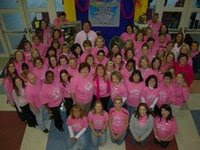
This year as I battled breast cancer and fought the hurricane within myself, I felt totally surrounded and protected by every person here at Chets Creek. Each of you was my own personal storm shelter. You gave me comfort, strength, support and courage through your prayers and hugs and notes and pink shirts. I was and am still overwhelmed daily by your outpouring of love!!!!. You made the difficult and unknown easier to bear. I believe that because of this I am stronger, calmer, and indeed a more grateful servant.
And in the true Chets Creek spirit, you have encompassed countless others with your support. You walk, run, collect pennies, and sell lemonade in the hopes of finding a cure for cancer. I believe it can be done! THANK YOU!
It has been six months since my surgery and over spring break I had my first post-op mammogram. It came back crystal clear. Life is good.
With sincerest gratitude,
Betsy
Dear Karen,
 Thanks for passing the Tinkerbell on to me. I am humbled, honored, and……….a little speechless. It is difficult for me to talk about myself, but I will try my best to answer your question.
This week at Atlantic Beach the surf has been pounding, the wind is blowing, the sky is gray-it’s a typical nor’easter along the coast. So as I reflect on your question, I keep thinking of the weather.
Often times at work, I feel like a hurricane wind is blowing. Students, parents, meetings, papers, testing, and deadlines all swirl around me with gale force intensity. Every now and then I can feel this power roaring on the inside and I feel anything but “calm, cool, and collected.” When this happens, I just step away from the situation for a little while, debrief with a mentor, work a crossword or listen to some music. A simple time out will usually bring out the peaceful, soothing sunshine.
Most of the time however, I feel like the eye of the hurricane; that calm and quiet place in the middle of a turbulent storm. No matter what is going on around me, I am blessed with the gift of keeping a cool head. Even in the worst of storms, like Katrina, I picture myself in a helicopter throwing a lifeline down to a family that is stranded on the roof of their house. No matter how tough a situation, there is always a solution to be found. Sometimes it takes a whole team of people working, planning and scheming for months on end. Other times it just takes a moment to stop and share an umbrella and a smile. This determination to find a solution is one thing that keeps me surrounded by tranquility.
I truly feel like listening and reflecting in a peaceful manner is a gift I have had all my life. Even in high school friends would share their most intimate problems with me. Somehow I am that little lifeboat that can slowly sail along and pick up one person at a time and move them to safety. I am truly blessed to incorporate this gift into my daily work.
I can’t stop without a more personal note……..I guess I am not so speechless…
I count my blessings everyday and this also keeps me focused and calm. To have this wonderful job, at this amazing school, among such talented people is indeed a dream come true.
This year as I battled breast cancer and fought the hurricane within myself, I felt totally surrounded and protected by every person here at Chets Creek. Each of you was my own personal storm shelter. You gave me comfort, strength, support and courage through your prayers and hugs and notes and pink shirts. I was and am still overwhelmed daily by your outpouring of love!!!!. You made the difficult and unknown easier to bear. I believe that because of this I am stronger, calmer, and indeed a more grateful servant.
And in the true Chets Creek spirit, you have encompassed countless others with your support. You walk, run, collect pennies, and sell lemonade in the hopes of finding a cure for cancer. I believe it can be done! THANK YOU!
It has been six months since my surgery and over spring break I had my first post-op mammogram. It came back crystal clear. Life is good.
With sincerest gratitude,
Betsy
Thursday, March 20, 2008
Kindergarten Forever (Karen Meissner)
Karen,
"If" Kindergarten were phased out, what other grade would you consdier teaching and why? Gerri Smith

Gerri, Gerri, Gerri,
Thank you for bestowing the “Pixie” to me! However, since in my opinion your question is merely a “hypothetical” one because KINDERGARTEN is the initial and vital foundation of all future learning, I don’t think it’s going “away” any time soon. So in order to try to answer your question, I feel I must provide some background of my prior experiences in education.
In January ’82 I accepted a position as a teacher assistant at Mayport Elementary in a self-contained EH (Emotionally Handicapped) classroom because my two best friends were teachers there. (I had previously been working as a full-time hair stylist.) After staying in that position for 1 ½ years, I “begged” my principal to move me because Special Ed just wasn’t my niche (ironic, isn’t it, since Kindergarten presents unique and special challenges each year?) The next year the principal humored me by moving me to Kindergarten. I felt like Art Linkletter—kids do say the “darnedest” things. I stayed in that position for the next 3 ½ years before deciding to return to college to pursue an Early Childhood degree. I found my “happy place” and kindergarten was fun!
So, after about 13 years since last being a college student, I spent the next 5 years being a student and becoming a mom (Hank ’88, Max ’90). A few months after getting my degree, the principal who humored me so many years earlier arranged my first interview for a teaching position. In August ’92 I accepted a 2nd grade teaching position at Central Riverside (sight unseen & before its major remodeling). Six weeks into the year I was switched to 1st grade because of low enrollment/budget issues. The next year I had a 1-2 combination class and my third year there I was back in 1st grade. At the end of that year I applied for a transfer to be closer to home and to have more time with my young sons. I was luckily offered a 1st grade position at Alimacani (our neighborhood school—YEAH!) because of some short-lived class-size reduction legislation. The legislation was soon rescinded due to “funding” issues (Imagine that!), but because in those days Alimacani was a multi-track school and I’d already begun teaching I got to stay (Hallelujah!). My next year there I was a “roving” 1st grade teacher (it would take another Pixie Pointer to explain “roving”). And then along came a school called “Chets Creek.” I was surplused to Chets and was scheduled to teach a 4-5 combination class (THANK YOU Anne & Lori!), but during the summer I got a call (on my birthday—Oh, what a “gift”) offering me a Kindergarten position! I never gave up my “hope” of becoming a Kindergarten teacher! I give thanks each day and pray for patience and guidance to follow the path that God has set for me. So, as you can see, I was “blessed” by being surplused to Chets for the opportunity it has provided me to do what I love each and (almost) every day. My experiences have “taught” me to “keep the faith” and to trust in the decisions of others. I hope to continue laying that vital foundation for PRIMARY students (or I guess I could always go back to hair styling—just kidding). I love being a part of the Chets Creek family and I JUST WANT TO HAVE FUN!
Karen
"If" Kindergarten were phased out, what other grade would you consdier teaching and why? Gerri Smith
Gerri, Gerri, Gerri,
Thank you for bestowing the “Pixie” to me! However, since in my opinion your question is merely a “hypothetical” one because KINDERGARTEN is the initial and vital foundation of all future learning, I don’t think it’s going “away” any time soon. So in order to try to answer your question, I feel I must provide some background of my prior experiences in education.
In January ’82 I accepted a position as a teacher assistant at Mayport Elementary in a self-contained EH (Emotionally Handicapped) classroom because my two best friends were teachers there. (I had previously been working as a full-time hair stylist.) After staying in that position for 1 ½ years, I “begged” my principal to move me because Special Ed just wasn’t my niche (ironic, isn’t it, since Kindergarten presents unique and special challenges each year?) The next year the principal humored me by moving me to Kindergarten. I felt like Art Linkletter—kids do say the “darnedest” things. I stayed in that position for the next 3 ½ years before deciding to return to college to pursue an Early Childhood degree. I found my “happy place” and kindergarten was fun!
So, after about 13 years since last being a college student, I spent the next 5 years being a student and becoming a mom (Hank ’88, Max ’90). A few months after getting my degree, the principal who humored me so many years earlier arranged my first interview for a teaching position. In August ’92 I accepted a 2nd grade teaching position at Central Riverside (sight unseen & before its major remodeling). Six weeks into the year I was switched to 1st grade because of low enrollment/budget issues. The next year I had a 1-2 combination class and my third year there I was back in 1st grade. At the end of that year I applied for a transfer to be closer to home and to have more time with my young sons. I was luckily offered a 1st grade position at Alimacani (our neighborhood school—YEAH!) because of some short-lived class-size reduction legislation. The legislation was soon rescinded due to “funding” issues (Imagine that!), but because in those days Alimacani was a multi-track school and I’d already begun teaching I got to stay (Hallelujah!). My next year there I was a “roving” 1st grade teacher (it would take another Pixie Pointer to explain “roving”). And then along came a school called “Chets Creek.” I was surplused to Chets and was scheduled to teach a 4-5 combination class (THANK YOU Anne & Lori!), but during the summer I got a call (on my birthday—Oh, what a “gift”) offering me a Kindergarten position! I never gave up my “hope” of becoming a Kindergarten teacher! I give thanks each day and pray for patience and guidance to follow the path that God has set for me. So, as you can see, I was “blessed” by being surplused to Chets for the opportunity it has provided me to do what I love each and (almost) every day. My experiences have “taught” me to “keep the faith” and to trust in the decisions of others. I hope to continue laying that vital foundation for PRIMARY students (or I guess I could always go back to hair styling—just kidding). I love being a part of the Chets Creek family and I JUST WANT TO HAVE FUN!
Karen
Wednesday, March 12, 2008
4th Grade Writing Tips (Gerri Smith)
GERRI SMITH – How do you manage to get such great Writing scores out of many low-performing students every year? Is there a special secret or skill you can share? (from Anne Tillis)
 Anne it’s amazing that you asked me this question. I’ve never given serious thought to how I get the scores I get except prayers. I prayer on behalf of every child. As I look back on the students that I’ve taught, I now see one thing that is common with all the children that wanted a “6.” They had a passion that drove them to receive and believe everything that came out of my mouth regarding strategies that could improve their writing. On the other hand some students come to fourth grade not knowing anything about writing. So I allow them to jump in at their own pace until they are comfortable with what we are doing in class. Comfortable means sitting in my office with BC and writing down everything he is trying to tell me about his vacation. When I read it back to him, he says, “No, that’s not right,.I’ll write it myself!” After several visits in my office he now believes he can do it himself. How about MB who hid under his desk the first time we started to write in his class? He too, ended up in my office and we had a discussion to try and figure out what I needed to do to help him. Whatever it takes to win their confidence in me helping them achieve, I’ll do it. There’s no formula or straight shot to getting good results . Each child and each class is unique in their own way and I have the privilege of finding that out each new school year.
Thanks for asking,
G. Smith
 Anne it’s amazing that you asked me this question. I’ve never given serious thought to how I get the scores I get except prayers. I prayer on behalf of every child. As I look back on the students that I’ve taught, I now see one thing that is common with all the children that wanted a “6.” They had a passion that drove them to receive and believe everything that came out of my mouth regarding strategies that could improve their writing. On the other hand some students come to fourth grade not knowing anything about writing. So I allow them to jump in at their own pace until they are comfortable with what we are doing in class. Comfortable means sitting in my office with BC and writing down everything he is trying to tell me about his vacation. When I read it back to him, he says, “No, that’s not right,.I’ll write it myself!” After several visits in my office he now believes he can do it himself. How about MB who hid under his desk the first time we started to write in his class? He too, ended up in my office and we had a discussion to try and figure out what I needed to do to help him. Whatever it takes to win their confidence in me helping them achieve, I’ll do it. There’s no formula or straight shot to getting good results . Each child and each class is unique in their own way and I have the privilege of finding that out each new school year.
Thanks for asking,
G. Smith
Tuesday, March 11, 2008
Strategies for Reluctant Readers (Lauren Werch)
Dear Lauren~
You and I have worked together for almost 10 years! However, you never cease to amaze me with your patience, love, and strategies! You are a true advocate for all children!
Question~ I have seen you work miracles with reluctant readers. Please share some of your favorite and most successful strategies.
Love ya!
Christina
Christina,
Thank Goodness you aren’t asking me for math strategies because that is where I learn from you! Before I initiate strategies with our many reluctant readers, I use three “best practices” that are already used by many teachers at Chets.
The first best practice I use is to build a strong relationship with these readers. They need extra love, trust and someone that believes in them. They also need a lot of motivation!
The second best practice I use is to diagnose specifically the reader’s strengths and weaknesses using reliable assessments. Knowing what I must teach the reader is essential to helping them move forward and target interventions appropriately to the area of reading they need.
Finally, the third best practice I use is to reduce the student ratio as much and as often as possible to either small group (3-5 students) or individual instruction. In all the years I have been attending reading conferences and reading the research, it is always the instructional intervention cited as being most effective.
Once I have completed this “up front” work, the following are some of the intervention programs or strategies I have found to work the best in each area of reading (however, I am ALWAYS looking for new ideas!)
PHONEMIC AWARENESS: Although I encounter very few readers with this need, the Great Leaps program has worked really well for this area of reading.
PHONICS: I am blessed to have been trained in one of the premier reading programs called Lindamood Bell. This program gave me the best foundation for teaching this area of reading, which is a sequential, direct instruction approach combining many modalities of learning.
FLUENCY: I have found out, most recently, that the most success to get readers on the road of fluent reading is to have them read a lot. Supported reading in text and repeated readings gives them the confidence to do this independently, which is the goal.
VOCABULARY: I always integrate new words within what we are reading and only a few at a time. I chose words I believe are most relevant to my readers.
COMPREHENSION: This cannot be ignored at any level of instruction, so I focus always on the areas of thinking a reader does before, during and after reading. Many times you must force a reader who struggles to stop and do this thinking.
I hope this helps someone in someway. I would really appreciate any new or different ideas passed on to me- let’s get some conversation going!! Lauren
You and I have worked together for almost 10 years! However, you never cease to amaze me with your patience, love, and strategies! You are a true advocate for all children!
Question~ I have seen you work miracles with reluctant readers. Please share some of your favorite and most successful strategies.
Love ya!
Christina
Christina,
Thank Goodness you aren’t asking me for math strategies because that is where I learn from you! Before I initiate strategies with our many reluctant readers, I use three “best practices” that are already used by many teachers at Chets.
The first best practice I use is to build a strong relationship with these readers. They need extra love, trust and someone that believes in them. They also need a lot of motivation!
The second best practice I use is to diagnose specifically the reader’s strengths and weaknesses using reliable assessments. Knowing what I must teach the reader is essential to helping them move forward and target interventions appropriately to the area of reading they need.
Finally, the third best practice I use is to reduce the student ratio as much and as often as possible to either small group (3-5 students) or individual instruction. In all the years I have been attending reading conferences and reading the research, it is always the instructional intervention cited as being most effective.
Once I have completed this “up front” work, the following are some of the intervention programs or strategies I have found to work the best in each area of reading (however, I am ALWAYS looking for new ideas!)
PHONEMIC AWARENESS: Although I encounter very few readers with this need, the Great Leaps program has worked really well for this area of reading.
PHONICS: I am blessed to have been trained in one of the premier reading programs called Lindamood Bell. This program gave me the best foundation for teaching this area of reading, which is a sequential, direct instruction approach combining many modalities of learning.
FLUENCY: I have found out, most recently, that the most success to get readers on the road of fluent reading is to have them read a lot. Supported reading in text and repeated readings gives them the confidence to do this independently, which is the goal.
VOCABULARY: I always integrate new words within what we are reading and only a few at a time. I chose words I believe are most relevant to my readers.
COMPREHENSION: This cannot be ignored at any level of instruction, so I focus always on the areas of thinking a reader does before, during and after reading. Many times you must force a reader who struggles to stop and do this thinking.
I hope this helps someone in someway. I would really appreciate any new or different ideas passed on to me- let’s get some conversation going!! Lauren
Tuesday, March 4, 2008
Inclusion (Christina Walag)
Dear Christina,
As a second grade mainstream teacher, please tell us how this classroom environment compares to a general education class. What obstacles/challenges have you encountered and how have you overcome them? How do you differentiate your instruction with such a wide variety of learners?
Love,
Brooke Dear Brooke~
I have been a mainstream teacher for most of my teaching career and I love it! How does my classroom compare to a general education class? I can only imagine… Through collegial conversations, there seems to be a wide diversity of learners in all classrooms…and many students with special needs that have not been identified yet.
Since the county has implemented Full Inclusion, we haven’t worked out the challenges of having students with more significant needs. Many of these students have never been in a large classroom setting. We are still trying to figure out how to fully meet their needs! However, in a collaborative effort with my awesome teaching partners, Lauren Werch and Lauren Morgan, we have learned how to think out of the box ! Here is a sample of some specific strategies we use in our classrooms:
« Technology
« Intervention Groups
« Behavior Plans
« Lots of Positive Reinforcement
« Flexibility
« A Sense of Humor
How do I differentiate instruction with such a variety of learners? I use a lot of peer support, repetition, positive feedback, small groups, and some students are given more time to complete assignments. I bet you didn’t know that often an ESE student is the one who gives support to a regular education student…What better way to build a child’s self-esteem!
Love~
Christina
As a second grade mainstream teacher, please tell us how this classroom environment compares to a general education class. What obstacles/challenges have you encountered and how have you overcome them? How do you differentiate your instruction with such a wide variety of learners?
Love,
Brooke
Dear Brooke~I have been a mainstream teacher for most of my teaching career and I love it! How does my classroom compare to a general education class? I can only imagine… Through collegial conversations, there seems to be a wide diversity of learners in all classrooms…and many students with special needs that have not been identified yet.
Since the county has implemented Full Inclusion, we haven’t worked out the challenges of having students with more significant needs. Many of these students have never been in a large classroom setting. We are still trying to figure out how to fully meet their needs! However, in a collaborative effort with my awesome teaching partners, Lauren Werch and Lauren Morgan, we have learned how to think out of the box ! Here is a sample of some specific strategies we use in our classrooms:
« Technology
« Intervention Groups
« Behavior Plans
« Lots of Positive Reinforcement
« Flexibility
« A Sense of Humor
How do I differentiate instruction with such a variety of learners? I use a lot of peer support, repetition, positive feedback, small groups, and some students are given more time to complete assignments. I bet you didn’t know that often an ESE student is the one who gives support to a regular education student…What better way to build a child’s self-esteem!
Love~
Christina
Teacher Mother (Anne Tillis)
Anne Tillis,
I have always admired you. I know you have been teaching for a long time. You are such an inspiration to me. You always have your act together. How do you manage being a mother of two wonderful children and teach effortlessly?
From Sherri Anderson
 Dear Sherrie,
Thank you for your very kind words, especially about my children. I am glad to know that people see them that way, as it has been just “we three” for the last 6 ½ years. I manage simply by following the same rules and standards that my parents instilled in me. They seem to have worked pretty well on my brothers and myself. They also know that they are my number one priority, and that I have high expectations for them both. I think our family has learned to rely on each other, and to support each other in both good times and bad. I am very proud of them both!
I am glad you think that my teaching is effortless, LOL! It really isn’t, and if you only knew how many sleepless nights I have, you would not say that! I think the fact that I am not afraid to try something new, and the great coaching I have received here at Chets, helps me to teach my students. I am very grateful for all the wonderful training I have received in the last ten years. I feel comfortable with what I am teaching, so that probably helps as well! I am not a mover and shaker kind of person, but I know that I can teach children, which in the end, is the MOST IMPORTANT job of all, both as a Mom and as a teacher working with the young minds of our future .
Love you,
Annie Bananie
I have always admired you. I know you have been teaching for a long time. You are such an inspiration to me. You always have your act together. How do you manage being a mother of two wonderful children and teach effortlessly?
From Sherri Anderson
 Dear Sherrie,
Thank you for your very kind words, especially about my children. I am glad to know that people see them that way, as it has been just “we three” for the last 6 ½ years. I manage simply by following the same rules and standards that my parents instilled in me. They seem to have worked pretty well on my brothers and myself. They also know that they are my number one priority, and that I have high expectations for them both. I think our family has learned to rely on each other, and to support each other in both good times and bad. I am very proud of them both!
I am glad you think that my teaching is effortless, LOL! It really isn’t, and if you only knew how many sleepless nights I have, you would not say that! I think the fact that I am not afraid to try something new, and the great coaching I have received here at Chets, helps me to teach my students. I am very grateful for all the wonderful training I have received in the last ten years. I feel comfortable with what I am teaching, so that probably helps as well! I am not a mover and shaker kind of person, but I know that I can teach children, which in the end, is the MOST IMPORTANT job of all, both as a Mom and as a teacher working with the young minds of our future .
Love you,
Annie Bananie
Friday, February 29, 2008
Humor (Sherri Anderson)
Sherrie Anderson— Please share how you infuse humor and engage all types of learners so effortlessly. How does this effect your relationship with the children in your care as well as their learning? (From Tammi Sani)  Dear Tammi,
 Dear Tammi,
 Thank you for your sweet words. I absolutely love my job, and I love to laugh! I remember when I was in elementary school. I felt sooooo lost most of the time. I didn't get what was going on. But when a teacher cracked a joke or was funny, I seemed to "get it." Since then, I have always wanted to find a way to reach children that seem as lost as I was back then. Laughter helps everyone feel comfortable. If I can help even one student feel capable of learning something new by making them laugh, what could be better? I know all children can learn. My challenge is to figure out how. By creating relationships with my students they are able to feel safe, are engaged, and ready to learn. They are willing to try much harder because they know I believe in them 100 percent! I absolutely relish hearing a child's laughter. A good belly laugh gets the juices flowing. Learning then becomes easy.
Your friend,
Sherrie Anderson
Your friend,
Sherrie Anderson
Subscribe to:
Posts (Atom)